
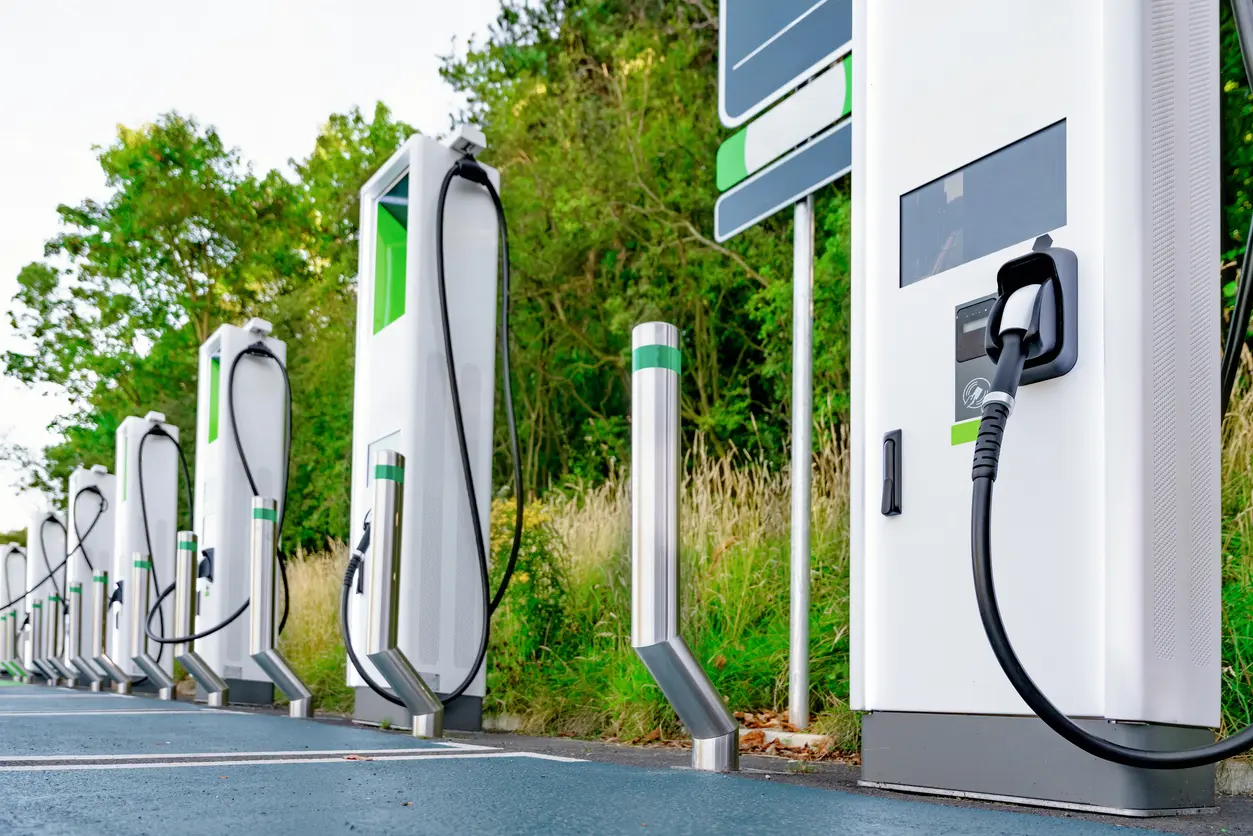
No matter if they’re sitting in a parking garage, at a rest stop, or along the edges of a busy retail center, EV charger enclosures need to withstand a lot.
Backed by proven expertise and capabilities, Fralo Industries fabricates and assembles EV charger enclosures that look professional and reliably protect the powerful systems inside. Reach out to our team today for a custom or ready-built solution.
Engineered for Real-World Conditions
Most EV charger enclosure failures start small, like a leaky seam or gasket that compresses unevenly and slowly lets in moisture. Before the first blank is cut, Fralo addresses these vulnerabilities with continuous door gaskets, welded seams, and cable entries positioned to direct water away from the cabinet rather than allow it to pool. Assemblies typically meet NEMA 3R requirements for general outdoor sites or NEMA 4 and 4X requirements for coastal locations.
Parts and Assemblies for EV Charging Stations
The durability and performance of our weatherproof EV charger enclosure is the result of precision fabricated components seamlessly coming together as one, including:
- Mounting brackets and pedestal hardware: From brackets and base plates to internal rails, Fralo forms EV charger enclosure mounting components to tight tolerances so holes line up correctly and installers can carry out the job efficiently.
- Branded panels and fascia: The front panel is the area of the enclosure that is seen the most, so we ensure that fascia and trim pieces have crisp bends and clean edges. We also apply color-matched powder coating and can add logo cutouts.
- Structural components: Canopy supports, cable management arms, and internal chassis frames are all included in this group. Because these parts need to support heavy loads, we pay particular attention to material gauge, weld, quality, and fit.
What’s the Best Material for Your EV Charger Enclosure?
The ideal material choice for every EV charger enclosure depends on its environment and its intended service life. Aluminum is a lightweight option that naturally resists corrosion, which makes it well suited for large rollouts. Galvanized steel is more rigid and cost-effective, while stainless steel is the preferred choice for coastal sites. Tell our team about your site conditions and the enclosure’s target service life, and we’ll recommend a gauge and allow that suits your application.
Managing Heat and Keeping Service Accessible
Modern EV chargers can power up vehicles fast, but that speed generates substantial heat. If that heat has nowhere to go, power modules derate and charging session slow down. Fralo Industries addresses this at the fabrication level with louver patterns that move air while shedding rain, plus mounts and filler frames built right into the panel.
Maintenance access is also an important engineering consideration. We create hinged doors with tamper-resistant fasteners that keyed locks keep each unit secure while still letting a technician service the unit without trouble.
Learn What Makes Fralo’s EV Charger Enclosures Uniquely Reliable
For EV charger enclosures engineered for long-term performance, call Fralo Industries. Our decades of expertise and advanced capabilities allow us to produce enclosures tailored to demanding environments and service requirements.
FAQs
What NEMA rating does an EV charger enclosure usually require?
It depends on the environmental conditions. NEMA 3R protects against rain, sleet, and snow for most general outdoor installations. Location near the ocean or anywhere hoses are used for cleaning usually call for NEMA 4 or 4x protection.
Does a stainless-steel EV charger enclosure need powder coating?
Not for corrosion protection. Stainless forms its own protective oxide layer, so many units ship with a brushed finish and no coating at all. Powder coating is added when a network wants its brand colors on the housing.
Can cooling features be built into the enclosure?
They can. Louvers, fan cutouts, and filter frames are formed directly into the sheet metal, which keeps the build clean and saves an assembly step.